Match-Day Tennis Blueprint 2026: Warm-Up, Hydrate, Fuel, Recover
 Tommy
Tommy
Why a minute-by-minute plan wins tournaments
Tournament days reward players who treat the hours around a match like part of the match. The right warm-up primes the nervous system, hydration keeps decision making crisp, and smart fueling maintains reliable racquet speed in the third set. This blueprint gives parents and adult players a clear, clock-based plan for three common start times in three common climates, plus exact hydration formulas, portable menus, and between-match protocols.
The hydration guidance below aligns with long-standing recommendations from the American College of Sports Medicine. If you want the full technical background on volumes, sodium, and sweat rate testing, read the ACSM fluid replacement guidance.
Bodyweight-based hydration and fueling rules
Use these as your default, then adjust based on sweat rate, urine color, and body mass change.
- Prehydrate 3 to 4 hours before first serve: 5 to 7 milliliters per kilogram of body mass. Quick rule for parents and players who think in pounds: multiply bodyweight in pounds by 0.08 to 0.11 to get ounces to drink across that window. Example: a 140 pound player aims for about 11 to 15 ounces spread across 3 to 4 hours.
- If urine is still dark 1 to 2 hours pre-match, add another 3 to 5 milliliters per kilogram, or about 0.05 to 0.08 ounces per pound.
- During play, target 0.4 to 0.8 liters per hour, roughly 14 to 27 ounces per hour, guided by thirst and the day’s heat. That often maps to 5 to 10 ounces at each changeover.
- Sodium: for matches longer than 60 minutes, 300 to 600 milligrams of sodium per hour helps keep plasma volume up and reduces cramping risk. Salty sweaters may need more.
- Carbohydrate during play: 30 to 60 grams per hour from gels, chews, sports drink, applesauce pouches, or easy-to-chew rice cakes.
- After play: replace 150 percent of body mass lost over the next 4 to 6 hours, include sodium, and eat a recovery meal with 1.0 to 1.2 grams of carbohydrate per kilogram plus 20 to 30 grams of protein.
- Caffeine is optional and not for everyone. If used, 1 to 3 milligrams per kilogram 45 minutes pre-match is a conservative range. Juniors should only use caffeine with parental and coach approval and after trial in practice, not on tournament day one.
Portable match-day menus
Think low fiber, moderate protein, familiar foods, and enough sodium to match the day’s sweat.
- Pre-match breakfast ideas, 2 to 3 hours before: oatmeal with banana, honey, and a pinch of salt; low fiber bagel with turkey and a slice of cheese; white rice with two scrambled eggs and soy sauce; Greek yogurt with berries and pretzels.
- Top-off snack, 30 to 45 minutes before: applesauce pouch, one half banana with peanut butter, a small rice cake with honey, or a handful of energy chews with water.
- In-match fuel, at changeovers: 4 to 8 chews or one gel per hour plus sips of sports drink; salted rice balls the size of a ping pong ball; pretzels; cut fruit if tolerated.
- Between matches: chocolate milk plus pretzels, or a turkey and cheese wrap on a white tortilla, or a bowl of white rice with soy sauce and shredded chicken. Keep fiber low to avoid gut distress when you re-warm.
- Hydration pack: two bottles, one plain water, one electrolyte drink with at least 300 milligrams sodium per 16 ounces. Add a small container of table salt to boost sodium if heat is severe.
Dynamic warm-up and serve ramp, step by step
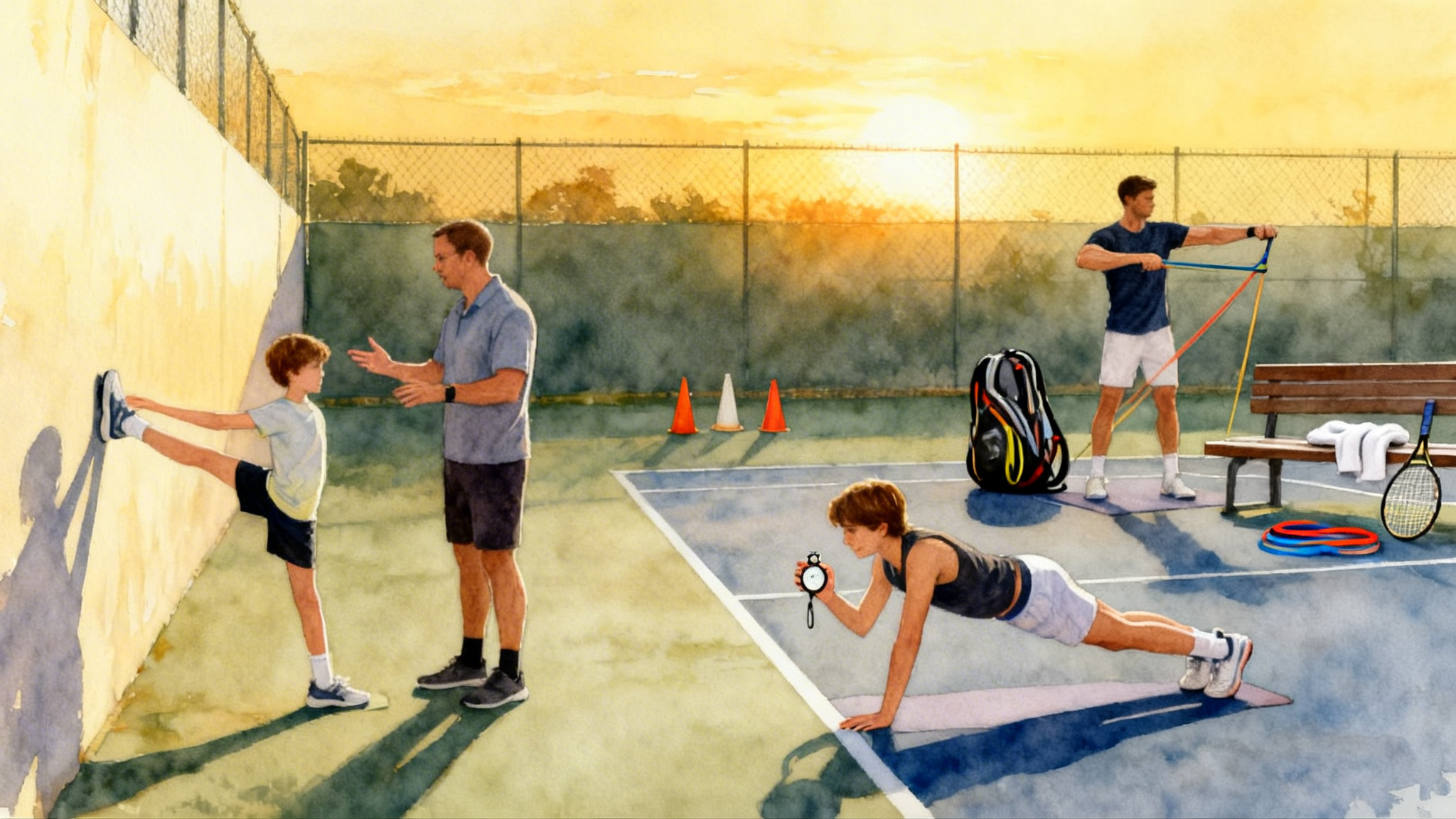
This is your universal template. Total time: about 12 to 15 minutes. Do it in a small open area near the courts.
-
Tissue temperature and rhythm, 3 minutes: brisk walk into light jog, backward jog, side shuffles, carioca. Add 10 skipping strides and 10 high-knee strides.
-
Mobility under motion, 3 minutes: walking knee hugs and heel-to-glute pulls, ankle circles, leg swings front to back and side to side, arm circles small to large, thoracic rotations.
-
Activation and posture, 3 minutes: mini band walks forward and lateral, 10 slow bodyweight squats pausing at the bottom for one breath, 10 hip hinges, 10 standing Y T W shoulder patterns.
-
Elasticity and acceleration, 3 minutes: 2 sets of 10 pogo hops, 2 sets of 10 low split-step hops, 3 accelerations of 10 to 15 meters at 70, 80, and 90 percent.
-
Racket skills, 3 to 5 minutes: shadow swings forehand and backhand, 10 smooth reps each, then short on-court mini tennis if courts are open. End with the serve ramp: 5 half-speed shadow serves, 5 at 70 percent to the deuce box, 5 at 80 percent to the ad box, 6 at 90 percent alternating boxes, 4 spin serves to targets. For technical checkpoints under pressure, see the serve blueprint checkpoints.
Three start times, three climates: your timed plan
Below are clock-based scripts for a junior or adult player. Parents can be the timekeeper. Adjust volumes for body size using the formulas above. If a match is delayed, hold the warm-up at T minus 20 minutes and re-run steps 3 to 5 from the warm-up section when you get the new time.
A. 7:30 a.m. start, cool morning
- Night before, 7:30 p.m.: Pack bag using the checklist below. Eat a balanced dinner with starch, lean protein, vegetables, and a salty element. Fill two bottles, one water, one electrolyte.
- Night before, 9:30 p.m.: Lights out. Set two alarms. Lay out warm layers for a cool start.
- Wake, 5:45 a.m.: Light snack if you tolerate early eating, such as a banana or applesauce pouch. Sip 6 to 8 ounces of electrolyte drink.
- T minus 90 minutes, 6:00 a.m.: Begin prehydrate target for the morning, approximately 0.1 ounce per pound across the next hour. Keep sips steady rather than chugging.
- T minus 60 minutes, 6:30 a.m.: Breakfast if not eaten earlier, such as oatmeal with honey and salt or a bagel with turkey. 16 to 20 ounces of fluid if urine is still dark.
- T minus 30 minutes, 7:00 a.m.: Dynamic warm-up, steps 1 to 4.
- T minus 15 minutes, 7:15 a.m.: Serve ramp. Top-off snack, such as a half banana. 5 ounces of water.
- First three games: Play high percentage patterns while your feel settles. Take 1 to 2 swigs at each changeover.
- Changeovers: 5 ounces water or electrolyte. If set extends past 40 minutes, begin 20 to 30 grams carbohydrate per hour from chews or drink.
- Between matches: Cool-down 5 minutes easy walk, 2 minutes breathing through the nose with long exhale, 10 light mobility moves. Snack with 40 to 60 grams carbohydrate plus 16 to 24 ounces of electrolyte drink over the next hour.
- Re-warm, T minus 15 minutes of next match: Run warm-up steps 2 to 5 again, shorter versions.
Why the emphasis on layers: in cool conditions muscle temperature is slower to rise, so a longer buildup preserves the first-serve percentage without over-swinging.
B. 11:00 a.m. start, warm conditions
- Night before, 8:30 p.m.: Lay out a sun plan, sunscreen, hat, two towels, and a cooling cloth.
- Wake, 7:00 a.m.: Breakfast 2 to 3 hours before, for example rice and eggs or yogurt and pretzels. Start prehydration with 0.1 ounce per pound over the next 90 minutes.
- T minus 90 minutes, 9:30 a.m.: If urine is still dark, add another 0.05 to 0.08 ounce per pound in this hour. Add 300 to 400 milligrams sodium from sports drink or a light salt sprinkle on food.
- T minus 45 minutes, 10:15 a.m.: Head to shade. Apply sunscreen. Set up court-side station: water, electrolyte, chews, towel, spare grip, ice cloth in cooler if available.
- T minus 30 minutes, 10:30 a.m.: Dynamic warm-up, steps 1 to 4. Finish with 3 accelerations at 90 percent.
- T minus 15 minutes, 10:45 a.m.: Serve ramp. Top-off snack with 20 grams carbohydrate. 6 ounces electrolyte drink.
- During play: Aim for 6 to 8 ounces fluid each changeover. Start 30 grams carbohydrate per hour at the 30-minute mark. If sweat is salty on your cap or shirt, target the higher end of sodium, up to 600 milligrams per hour.
- Between matches: Shade and shoes off for 3 minutes to cool. Walk 5 minutes, then mobility. Intake 0.5 liters electrolyte and 40 to 60 grams carbohydrate over 45 minutes. If the next match is within 90 minutes, keep protein light.
- Re-warm, T minus 12 minutes: Repeat warm-up steps 2 to 5 with smooth tempo.
C. 2:00 p.m. start, hot and humid
Humidity blunts sweat evaporation and raises heat strain. Cooling strategy matters as much as volume. The National Athletic Trainers’ Association offers clear prevention guidance, including cold towels, shade, and sodium intake for heavy sweaters. For deeper reading, see the NATA heat illness statement.
- Night before, 8:00 p.m.: Stock ice chest with frozen water bottles, wet cooling towels in sealed bags, and extra electrolyte packets. Confirm there is shade at the site. Pack two light colored shirts per match.
- Morning, 8:00 to 10:00 a.m.: Begin a slow-drip prehydrate, about 0.1 ounce per pound across 2 hours, include 600 to 800 milligrams sodium. Eat a salty breakfast, such as a bagel and turkey with mustard and a side of pretzels.
- Late morning, 11:30 a.m.: Small top-up, about 0.05 ounce per pound, mostly electrolyte drink. Avoid overfilling the stomach.
- T minus 45 minutes, 1:15 p.m.: Move to the venue. Set up a shade station. Pre-cool with a cold, damp towel around the neck for 10 minutes while doing light mobility.
- T minus 25 minutes, 1:35 p.m.: Dynamic warm-up, steps 1 to 3, keep ground contact light. Pre-cool again for 5 minutes.
- T minus 12 minutes, 1:48 p.m.: Serve ramp. Sip 6 ounces electrolyte. Optional caffeine only if practiced before.
- During play: 8 to 10 ounces at each changeover, target the higher sodium range. If you feel sloshy, pause sips for one changeover and resume at a slower pace.
- Between sets: Use shade, pour water on forearms, neck, and calves, and wring a cold towel over shoulders. Keep breathing slow through the nose to calm heart rate.
- Between matches: 10 minutes active cool-down walk, 5 minutes with cold towel, light snack 40 to 60 grams carbohydrate, 20 ounces electrolyte over the hour. Change into a dry shirt and socks.
- Re-warm, T minus 10 minutes: Repeat steps 2, 4, and the serve ramp, but shorten the volume to avoid excess heat load.
Between-match cool-down and re-warm protocols
The purpose of a cool-down is to clear some metabolites, bring heart rate down, and begin fluid and sodium replacement without stiffness. The purpose of a re-warm is to restore joint temperature and timing without draining the tank.
- Cool-down, 10 to 15 minutes: 5 minutes easy walk with two long exhales per breath, 2 minutes of calf, hip flexor, and thoracic mobility, 3 minutes of light band work for shoulders. Sip 8 to 12 ounces electrolyte during this time.
- Recovery intake, 30 to 90 minutes: 40 to 60 grams carbohydrate, 300 to 600 milligrams sodium, and water to thirst. If the next match is more than 2 hours away, include 20 to 30 grams protein.
- Monitor sweat loss: if possible, weigh before and after a match without shoes and clothes change. Each pound lost is about 16 ounces of fluid deficit. Replace 150 percent over the next few hours along with sodium.
- Re-warm, 8 to 12 minutes: steps 2 to 4 from the dynamic warm-up. Follow with the serve ramp at 70, 80, and 90 percent to two targets.
Build joint resilience on training days with the 12 minute prehab routines.
The printable match-day checklist
Copy this into your notes and print it for tournament bags.
- Two bottles, one water, one electrolyte, labeled
- Extra electrolyte packets, table salt, small measuring spoon
- Cooling kit: two towels, cooling cloth, zip bag, ice chest
- Fuel kit: gels or chews, applesauce, bananas, rice cakes, pretzels
- Breakfast plan written down with timing
- Spare grip, hat, sunscreen, sunglasses
- Two extra shirts and socks
- Mini band, light long band, lacrosse ball for feet
- Notecard with bodyweight, fluid targets, and sodium target per hour
- Pen to log start times and finishes
- Warm-up script: steps 1 to 5
- Serve ramp targets drawn in small grid
- Between-match cool-down steps printed on card
- Emergency plan: phone charged, venue address, coach contact
Parent playbook: managing the edges
- Be the timekeeper, not the fixer. Announce the next step and let the player run it. Independence on match day builds composure on big points.
- Keep a light tone around food and drinks. Offer options rather than commands.
- Photograph the station setup the first time so you can recreate it quickly at the next event.
Adult player notes: customize without guessing
- If you cramp in the heat, track sodium per hour for three events in a row. Many heavy sweaters find they need 800 to 1,000 milligrams per hour in extreme humidity, which usually requires an electrolyte capsule plus a sports drink. Trial this on practice days, not at a championship.
- If you fade mentally, experiment with 30 grams carbohydrate per hour from liquid, not solid. Some adults think better on a steady trickle of glucose without chewing.
- If your shoulder tightens, expand the serve ramp by adding 10 external rotations with a band and 6 half-speed shadow serves before the first 70 percent ball.
How Legend Tennis Academy builds this into daily training
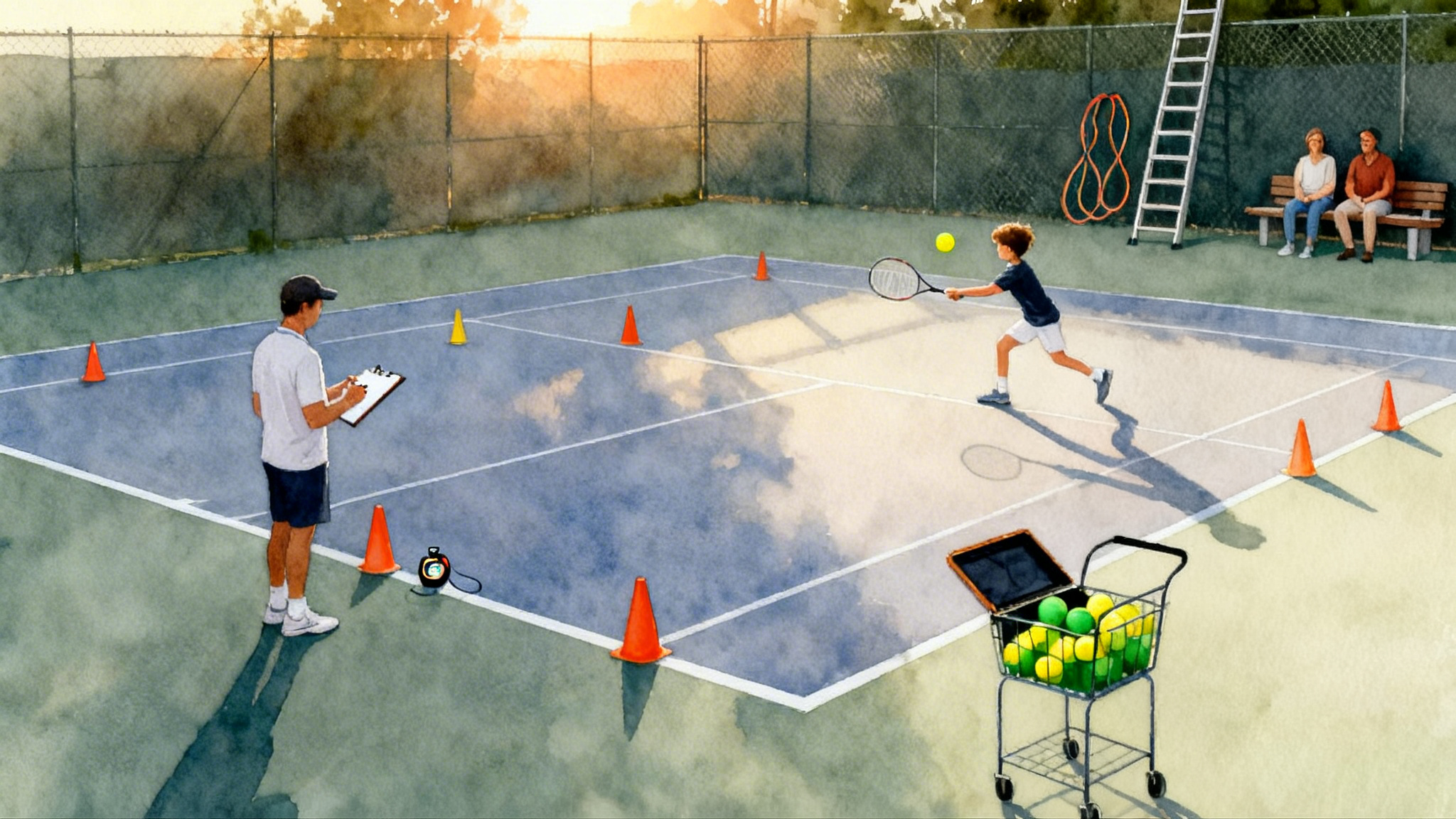
At Legend Tennis Academy in Spicewood, routines are taught before they are needed. Players practice the dynamic warm-up at the start of every session, then test the serve ramp under mild and hot conditions in the same week. Coaches put a small whiteboard near the water station with fluid targets by bodyweight so juniors learn the math and the feel at once. On heaviest days a coach runs a two-minute shade break drill that rehearses the between-set cooling routine, including a cold towel and a sodium sip. The routine is the same on match day, so players do not burn energy deciding what to do.
Parents can expect a short orientation about packing the bag the night before. Adult players can add a weigh-in test once per week to estimate sweat rate and dial in sodium. When a player struggles with late-match errors, the academy staff looks first at the routine: was the warm-up long enough for the weather, did the serve ramp reach 90 percent, did fueling start by the 30-minute mark. For technical refinement on the serve, skim the serve blueprint checkpoints.
If you want this structure built for your body, your schedule, and your climate, book an evaluation and we will map your hydration numbers, your warm-up timing, and your serve ramp together. Already training but want a tournament day rehearsal with a coach on site, including cooling setups and between-match planning, reserve a match-day planning session.
Final take
Tennis rewards the player who treats preparation as a skill. Use the formulas to set targets, use the timelines to guide your day, and use the warm-up and serve ramp to bring reliable speed without waste. Between matches, cool with purpose, replace what you lost, and re-warm just enough. Most of all, make it a habit in practice so tournament day feels familiar. The blueprint is simple, but following it with discipline is what turns tight sets into wins.