Grigor Dimitrov’s Academy Path: Sánchez-Casal to Mouratoglou
From Spanish clay bootcamps to Parisian precision, Grigor Dimitrov’s route through Sánchez-Casal and the Mouratoglou Academy shaped his junior majors in 2008, early ATP rise, and 2023–25 resurgence. Here is what families can copy.
 Tommy
Tommy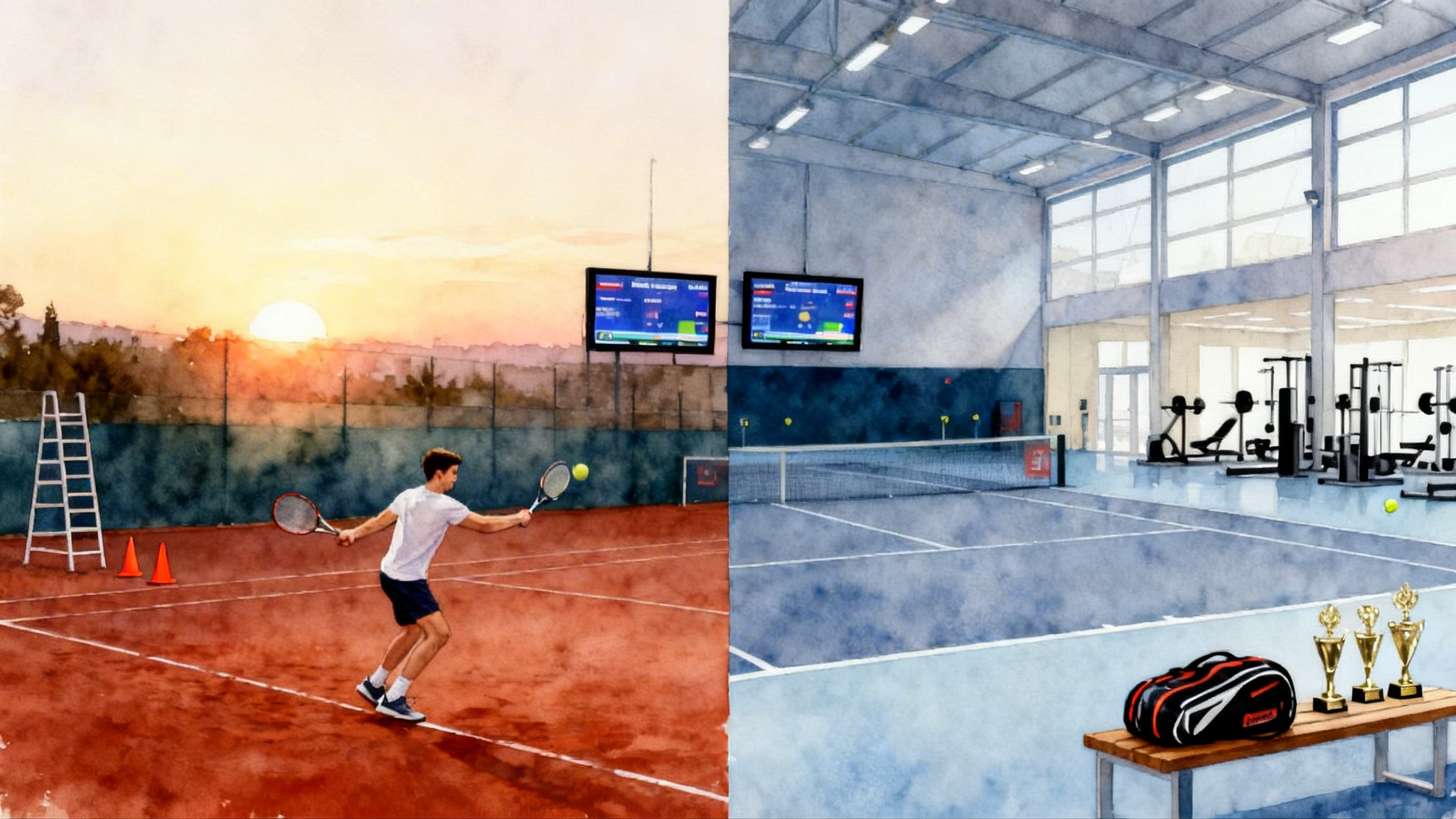
The two-academy arc behind an all-court artist
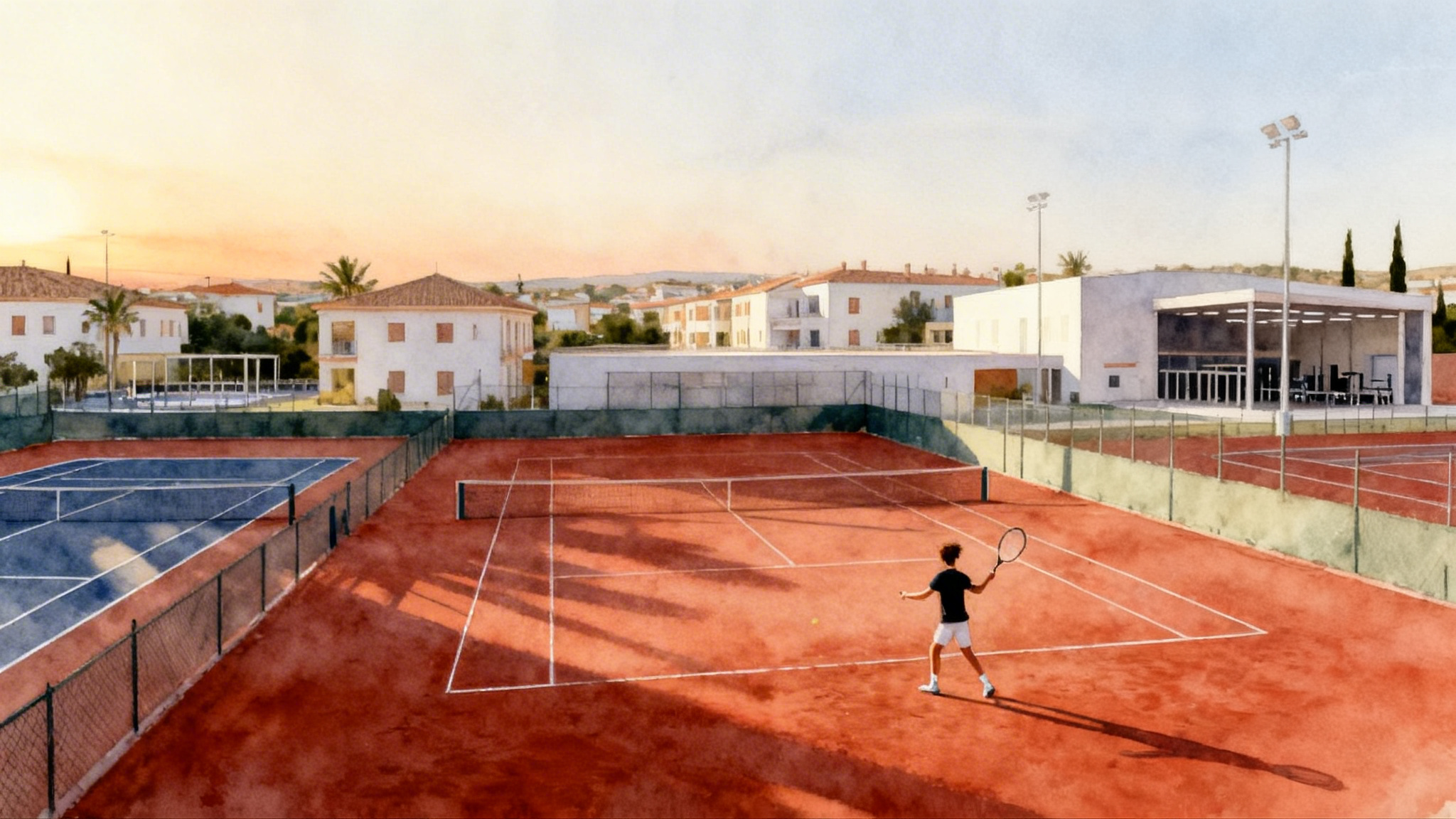
There is a clear through line from Grigor Dimitrov’s teenage years on Spanish clay to the veteran who, in his thirties, reentered the sport’s elite with deep Masters runs and a renewed presence at the business end of majors. As a teen he left Bulgaria for Barcelona’s Sánchez-Casal Academy, a place known for long training blocks on red clay and the daily habit of building footwork, balance, and point construction under fatigue. A couple of years later he shifted to Patrick Mouratoglou’s program near Paris, where the emphasis tilted to technical-tactical specificity, match simulations on faster courts, and the professionalism of a touring base. Dimitrov has spoken about that two-step decision in Dimitrov on both academies, and the results map onto the big moments of his career: the 2008 junior majors, the early ATP breakthroughs, and the 2023 to 2025 resurgence.
If you are weighing Spanish-style development, compare how other players combined clay foundations with pro polish in pieces like Ferrero Academy’s Alcaraz model and Mouratoglou’s junior blueprint.
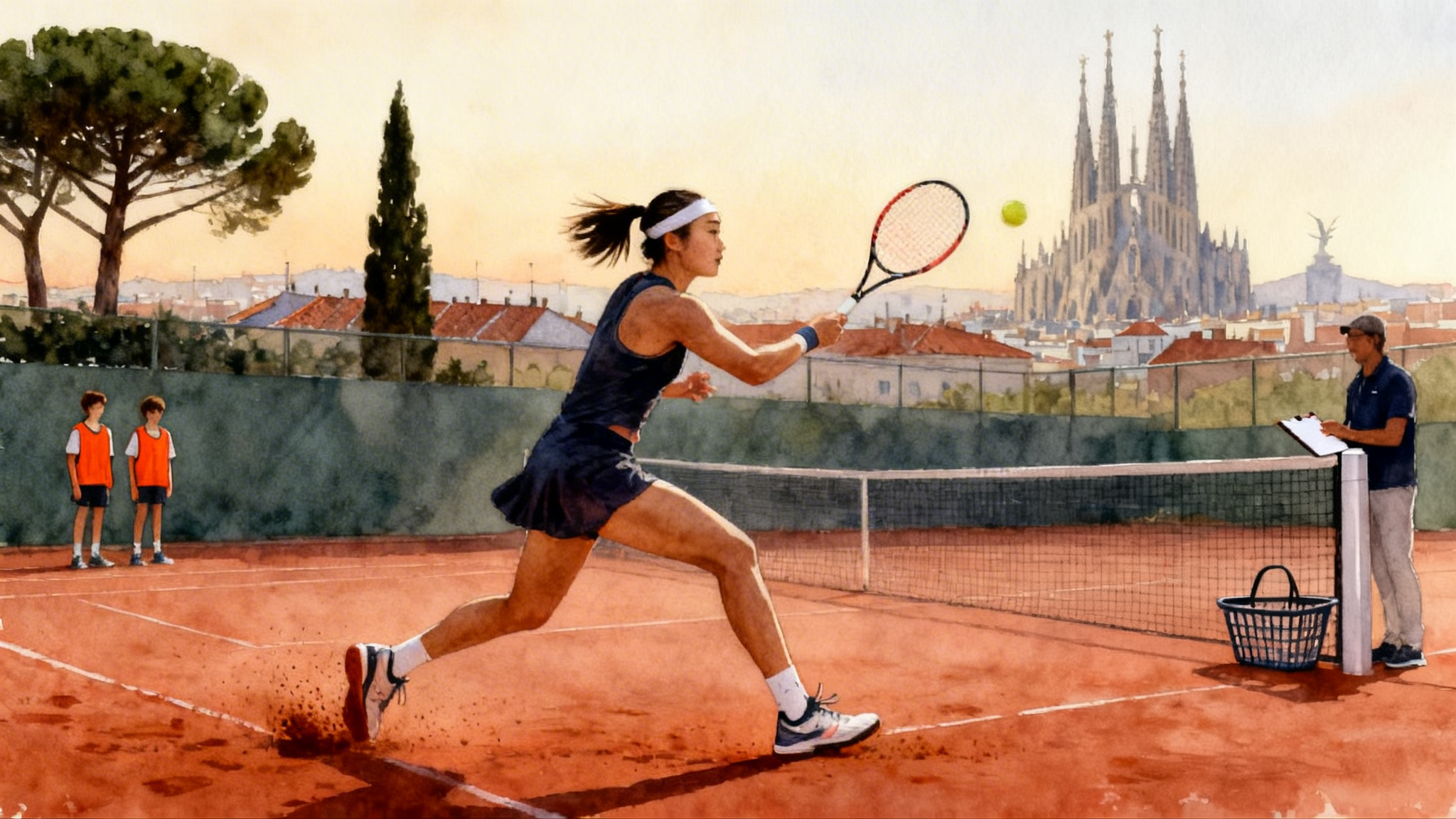
Barcelona, clay, and the habit of movement
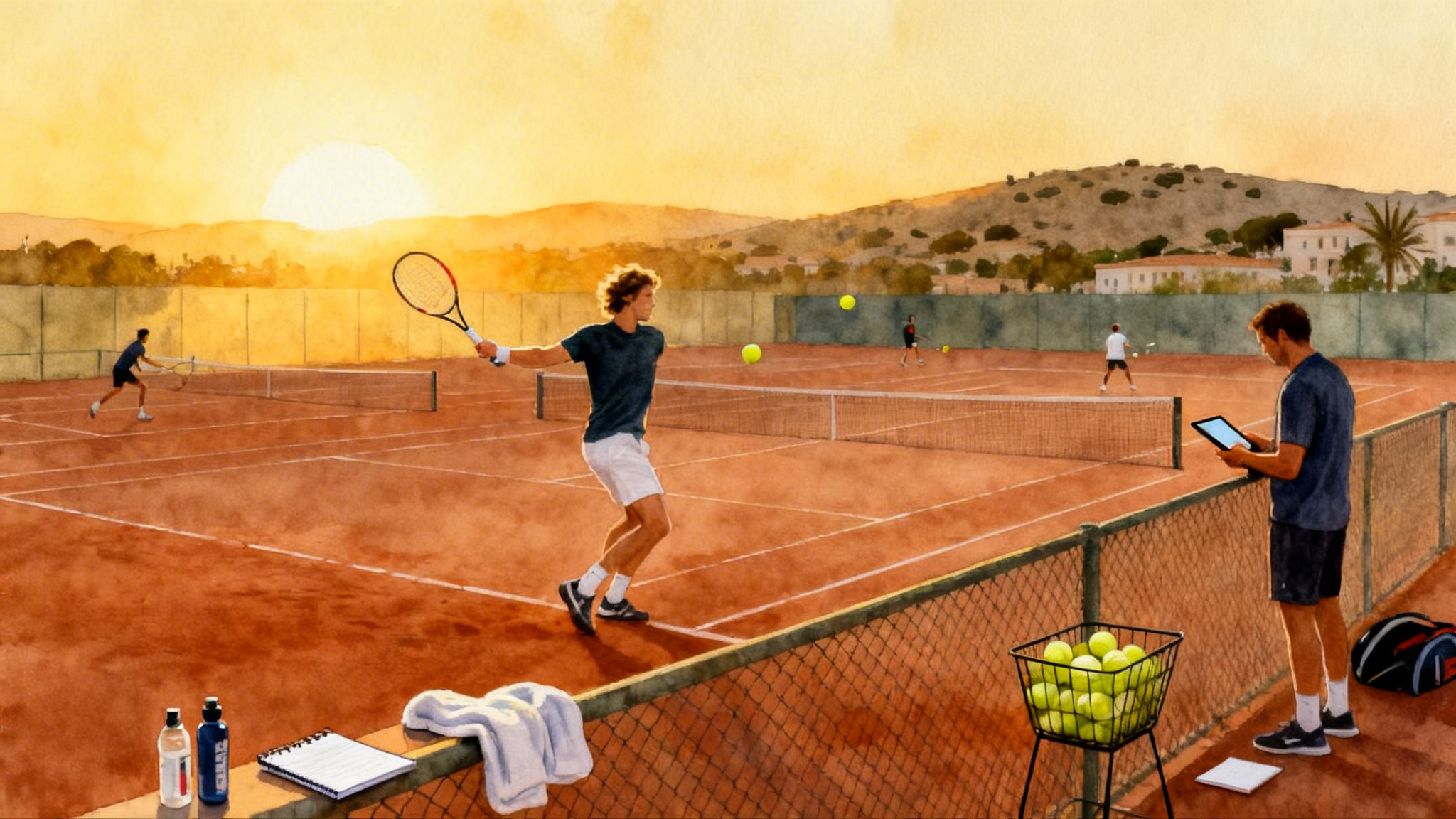
Sánchez-Casal is famous for turning repetition into intuition. Training days pile up like pages in a notebook. Players log volume on red clay, where the court writes honest feedback in every slide mark. For a teen Dimitrov, this meant three things that still show up in his adult game:
-
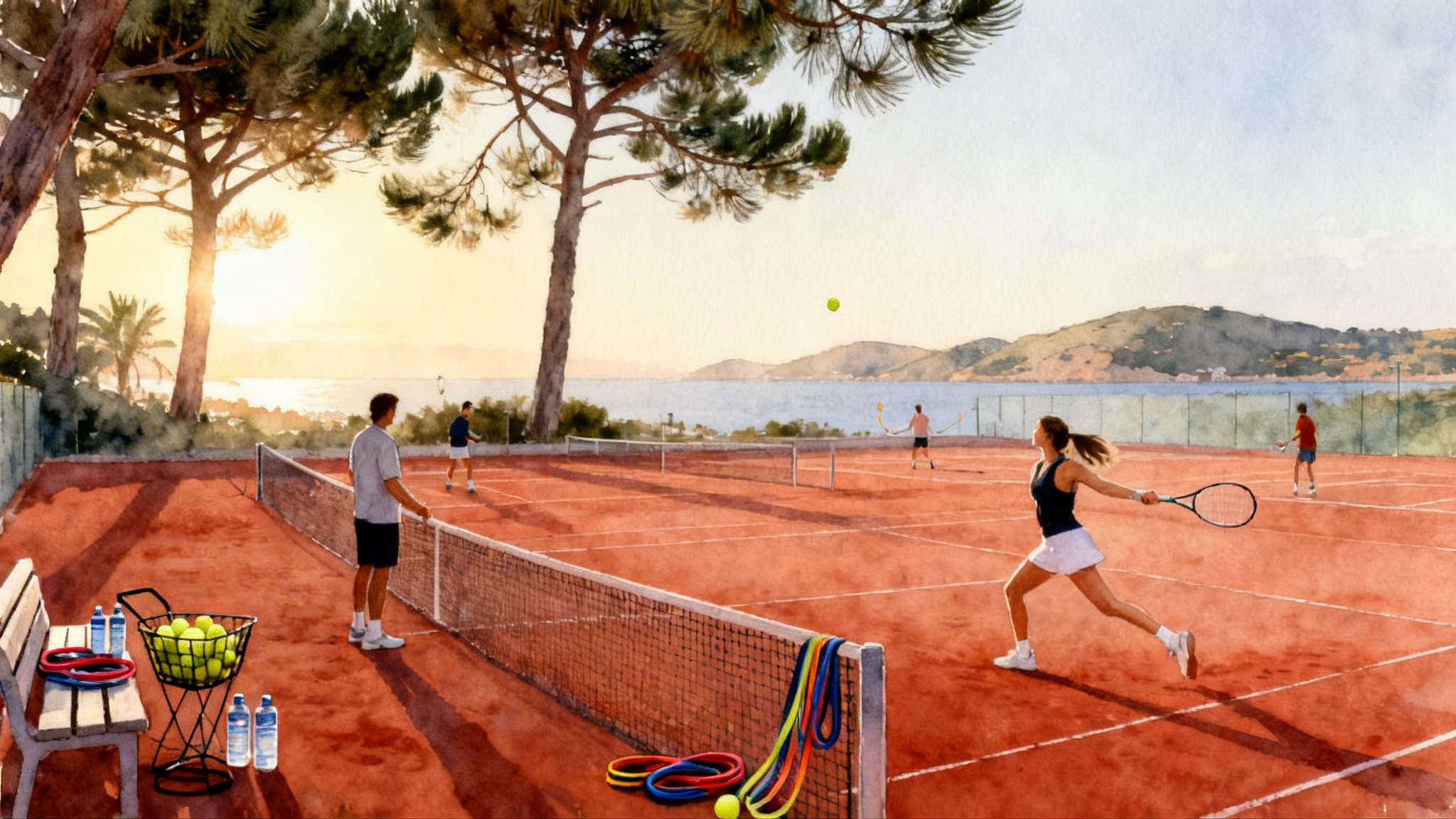
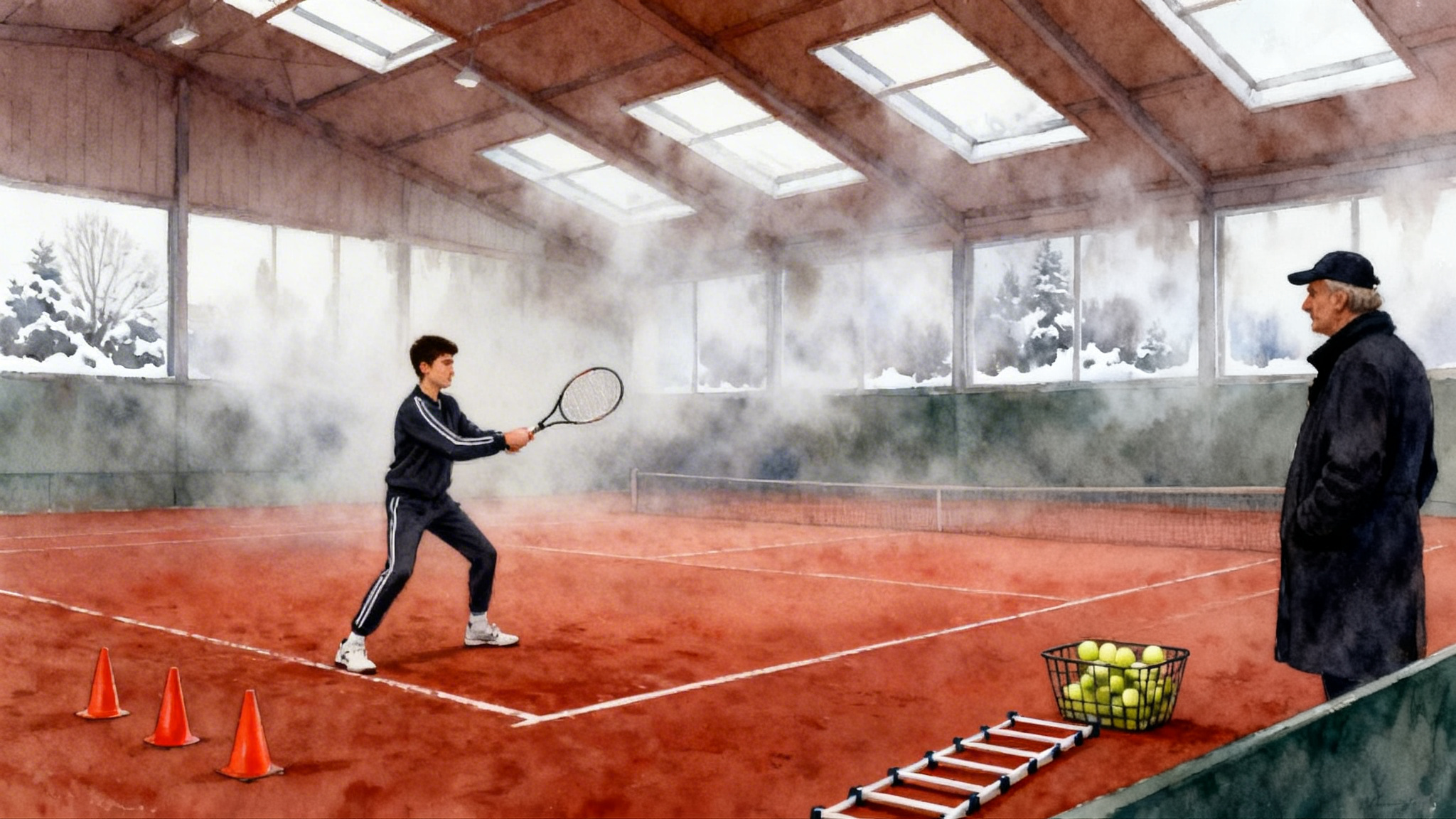
Volume footwork becomes automatic spacing. Clay forces you to organize your feet before you swing. On hard courts you can sometimes get away with late preparation. On clay, the ball exposes imprecise setup. Dimitrov’s fluid movement and ability to keep the ball in his strike zone were built one neutral-ball pattern at a time with ladders, cone gates, and side-to-side rallies that do not stop when you are tired, they start when you are tired.
-
Tolerance creates time. Those dreary, invaluable cross-court exchanges teach you to trade height, spin, and depth without forcing a resolution too early. The habit carries to faster courts. Watch Dimitrov on a quick indoor surface. He can absorb pace for three neutral balls, then change direction with his forehand, then take the court. That patience grew on slow dirt.
-
Clay footwork unlocks variety. The one-handed backhand slice, the sudden drop shot, the defensive squash forehand, the half-volley pick-up in a corner. These are not party tricks. On clay, they are survival tools. They later become ways to break opponent rhythm on grass and indoor hard.
The payoff arrived quickly. In 2008, Dimitrov won the Wimbledon boys’ singles and the US Open boys’ singles. That was less about teenage firepower and more about point management under pressure, a skill trained daily in Barcelona.
For a broader Barcelona lens, see the Barcelona pathway for Zheng Qinwen.
Paris, precision, and the pro transition
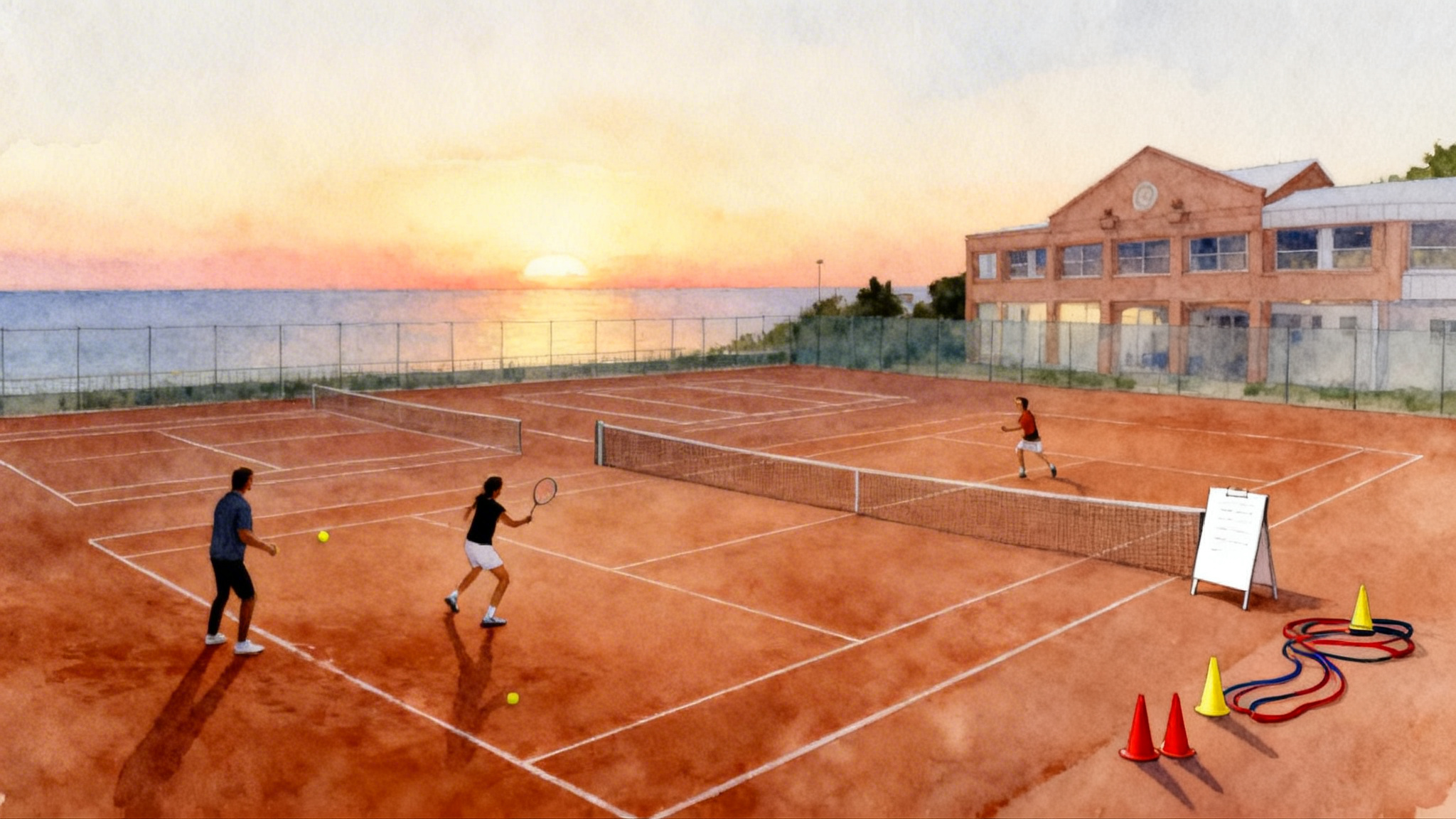
When Dimitrov joined Patrick Mouratoglou’s academy, the environment changed in three decisive ways: surface speed, structure, and specificity.
- Surface speed: Faster indoor and hard courts reward first-strike clarity. The academy leaned into serve patterns, return depth, and the first two balls after the serve. Dimitrov’s forehand, already heavy from clay reps, learned to land earlier, through the court, not just above the net.
- Structure: A pro base is not only about practices. It is stringing, recovery, strength planning, and logistics. The weekly microcycle looks like a chessboard: heavy load on movement and serve on day one, live sets on day two, reduced volume and video review day three, and so on. That order reduces aimless hitting and converts effort into outcomes.
- Specificity: Video and scouting helped translate feel into plans. Instead of generic work on the backhand, the session might target the backhand return against lefty slice wide on the deuce side, followed by the first step out of the return corner. Dimitrov’s later victories over big servers and his polished transition patterns reflect those block-by-block calibrations.
He briefly worked directly with Patrick Mouratoglou in 2012, then cycled to other teams, a normal path for a player refining his identity. The important part is that he kept using targeted blocks, often returning for short stints that solved a specific problem, rather than anchoring to one place out of habit.
The timeline, tied to environments and decisions
Strong careers do not move in a straight line. Dimitrov’s does make sense when you connect training choices to inflection points.
- 2008 juniors: The Barcelona foundation shows up in two junior majors. Those wins look like talent. They were also built on clay math: control height, control depth, then choose the moment to accelerate.
- 2013 to 2014 ATP lift: The transition from promise to results featured hallmark moments like beating Novak Djokovic in Madrid 2013, then a breakout 2014 with titles on three surfaces and a Wimbledon semifinal. That stretch looks like the Paris education taking root: first-strike clarity, plus the confidence to finish points at net.
- 2016 rebuild to 2017 peak: After a plateau, he rebuilt with a renewed fitness and planning phase that culminated in 2017 with the Cincinnati title and the season-capping ATP Finals. That arc is a poster for structured programming and trusting a team to sequence loads and competitions.
- 2023 to 2024 resurgence: Deep runs returned, including the Paris Masters final in November 2023 and a title in Brisbane in January 2024 that broke a long trophy drought. He then reached the Miami final in April 2024 and completed a rare full set of Masters quarterfinals and a Roland Garros quarterfinal that summer. The ATP Tour career overview tracks those results and also marks his year-end return to the top ten in 2024.
- 2025 consolidation under interruptions: Even with the inevitable bumps of a long career, the groundwork was solid enough that he stayed relevant at the biggest events. A player with a clear training compass can absorb temporary setbacks without losing the map.
Why the Spanish base travels everywhere
Families often ask whether investing early in clay is worth it if a player’s goals include hard-court success in the United States or grass-court bursts in Europe. Dimitrov is a living argument for yes. Here is why the clay foundation travels:
- Clay hardwires balance. Good clay movers learn to keep the head level through contact. That stability is why Dimitrov’s forehand looks unrushed even against huge pace on indoor courts.
- Clay creates time, which later becomes choice. On slow courts you learn to buy time with height and spin. On fast courts you spend that time, often to change direction or sneak forward behind a deep, heavy ball.
- Clay punishments build patience. Impatience is expensive on clay. Every rushed decision returns as a short ball for your opponent. By age eighteen, Dimitrov had already paid that tuition. The result is a veteran who can switch between trading and striking without emotional noise.
- Variety as a weapon, not a hobby. A slice approach, a short-angle forehand, a delayed drop, these are tools forged on clay that translate into hard-court problem solving. Dimitrov’s slice bite and short-angle forehand are classic examples.
What the Paris years add that clay alone cannot
- Serve first. Clay helps you rally. Pro tennis asks you to hold serve under pressure. The Paris emphasis on serve patterns, locations, and second-serve height gave Dimitrov a plan when matches got tight.
- Return depth and first step. Faster courts punish floating returns. Targeted blocks turned returns into assertive starts rather than neutral replies.
- Match simulation and scouting. Knowing an opponent’s favorite bailout pattern, and having a rehearsed answer, turns a coin flip into a nudge. Dimitrov’s late-career wins over top-ten players often look like he has that answer loaded.
- Microcycles that preserve freshness. As a pro, you cannot live in eight-hour academy days year-round. Short, specific blocks with exit criteria create improvement without fatigue debt.
Key decisions that changed his trajectory
- Switching training bases early: Leaving home for a clay-first academy created the motor habits he would later rely on. Moving again to a pro transition hub built the precision and professionalism to cash those habits against adults.
- Fitness rebuilds at the right moments: After stalls, he doubled down on conditioning and movement quality rather than only chasing new shots. The result was durability, especially noticeable in his thirties when many peers slowed.
- Coach changes with a purpose: He did not rotate for novelty. Each change aimed at a problem statement, whether it was clarifying first-strike patterns, retooling the serve, or balancing defense and offense. Reuniting with past coaches during the 2022 to 2025 window added continuity alongside freshness.
- Scheduling to create momentum: Brisbane in early January 2024 was not random. It offered winnable matches, familiar conditions, and confidence before Melbourne. The indoor European swing in late 2023 built reps that peaked in Paris. That is how you stack a season.
Patterns families can apply today
You do not need a top-ten budget to use the same logic. Here are concrete patterns parents and coaches can borrow.
1) When a change of training environment accelerates growth
Look for these signals over a 12-week period:
- The player wins or loses on the same terms every time. Example: they hit pretty forehands but get dragged into long neutral exchanges and leak errors late. If the home base does not supply a plan to fix the actual leak, a change helps.
- Practice quality exceeds match quality. If the player looks great in drills but cannot apply it on match day, they need blocks with point-based constraints, not more basket feeds.
- The footwork language no longer evolves. If your player’s split step is always late, the shuffle patterns are the same, and there is no surface variety, move to a place that treats movement as a skill, not a warm-up.
Action plan: Book a trial block of three to six weeks at a program that does two things your current base does not. For younger teens, clay volume and movement coaching are usually the best first upgrade. For older teens, add serve-return structure and match simulations.
2) How clay-based foundations translate to all-court weapons
Turn your red-dirt habits into points on faster courts with simple, trackable drills:
- Neutral-to-offense ladder: Start with five neutral cross-courts, then one offense ball down the line, then play out. Score only if you win without missing the offense ball. Track offense-ball errors per session.
- Slice threat index: In every practice set, mandate two backhand slices per game that change rally height. Track how many times those slices force a short ball.
- Serve plus two: On hard courts, script first-serve target to the body, first forehand to the open court, second forehand inside-out. Run twenty reps per side, then play a tiebreak using only that pattern on serve. Record hold percentage.
3) Use targeted academy blocks to solve specific gaps
Think like a product manager. Each block needs a problem statement, a metric, and an exit test.
- Problem: Second serve sits up and invites attack. Metric: Double faults per set under pressure, plus opponent return depth. Exit test: Win a practice set to 10 points serving only seconds, with fewer than two double faults and no more than three returns landing inside the service line.
- Problem: Backhand return breaks down against lefty slice wide. Metric: Return-in-play percentage and average depth. Exit test: In a lefty return drill of twenty wide slices, put fifteen returns past the service line and win four of six return games in a set.
- Problem: Transition hesitation. Metric: Opportunities taken to close on a short ball. Exit test: In two practice sets, convert at least 60 percent of short balls into a volley touch and win half of those points.
Block design: Two to three weeks, four on-court sessions and two gym sessions per week, plus one match-sim day with video. If the academy cannot state your problem, metric, and exit test in writing, it is not a targeted block.
4) A simple six-week schedule families can adapt
- Week 1 to 2: Clay volume and movement. Morning: cross-court tolerance and footwork grids. Afternoon: defense-to-offense patterns. Gym: single-leg strength and anti-rotation.
- Week 3: Serve and return on hard. Morning: serve patterns, spin control, body serve. Afternoon: return depth and first step. Gym: power and upper-body endurance.
- Week 4: Live sets with constraints. Example: one extra point for winning a rally after a backhand slice. Tiebreakers start at 5–all to train closing.
- Week 5: Tournament simulation. Two matches in one day. Focus on recovery habits, nutrition, and warm-ups.
- Week 6: Taper and compete. Enter a local or regional event. Keep the problem metric visible. Debrief with data, not vibes.
Evaluation checklist after any academy block
- Did the player’s movement look different at normal rally speed, not just in drills
- Can the player explain one specific pattern they trust on serve and on return
- Did the targeted metric improve by a number you can name
- Is there a realistic maintenance plan for the next four weeks at home
If you cannot answer yes, the block was probably long on atmosphere and short on coaching.
The takeaway for families
Grigor Dimitrov’s journey shows that environment is a lever, not a label. Barcelona’s clay gave him the motor and the patience to survive anywhere. Paris refined his aim, added pro-level structure, and taught him to finish points. In 2008 that blend won junior majors. In his early twenties it carried him through first big ATP wins. In 2023 to 2025 it made him newly dangerous against the very best, with titles and finals that rewarded not just talent but planning.
Your player does not need to copy his postcard or his grip. They can copy his process. Choose environments that teach what your current one cannot. Use clay to build movement and tolerance. Use targeted blocks to harden specific skills into match habits. Measure what matters, then let results, not slogans, tell you when to switch, when to stay, and when to double down on the hard work that travels with you anywhere.